
Research update
In recent years, high-profile attacks involving transgender perpetrators, including the 2023 Nashville school shooting and the 2025 Minneapolis school shooting, have generated attention within the threat assessment community and throughout our communities. For BTAM professionals, this raises a question: should gender identity factor into our risk matrix? Some are concerned that transgender individuals represent an emerging or disproportionate threat category. Before we adjust our practice based on that claim, it's worth examining what the data actually show across the major datasets we rely on for this work.
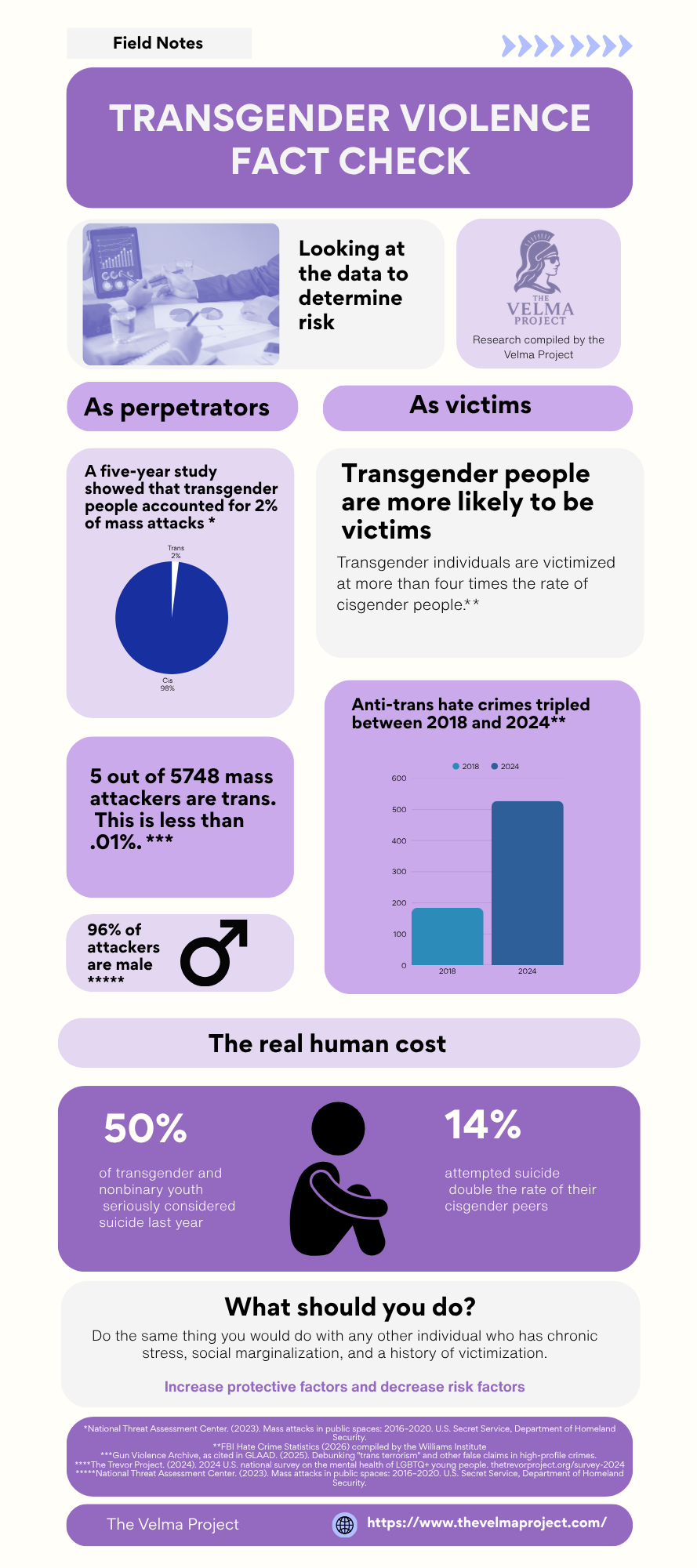
It is a good idea to start with the data and trans people and violence. We rely on some common and well researched data sets for much of our information about threat assessment. These include the U.S. Secret Service's National Threat Assessment Center, the Violence Prevention Project, the FBI's Active Shooter reports, and the Gun Violence Archive. The data shows that cisgender men account for the overwhelming majority of mass violence. The NTAC's comprehensive five-year study of mass attacks in public spaces found that 96% of perpetrators were male, with transgender individuals accounting for 2% of attackers across the entire dataset. This is three people out of 180.[1] The Gun Violence Archive, using the broadest possible definition of mass shooting, identified five confirmed transgender perpetrators out of 5,748 incidents over twelve years, representing less than one-tenth of one percent.[2] The narrative of trans people as a source of public danger is not supported by the evidence. It is, in fact, nearly the inverse of what the data shows.
Instead, the data shows that transgender people are more likely to be harmed than to harm others. According to the Williams Institute at UCLA, transgender individuals are victimized at more than four times the rate of cisgender people, 86 incidents per 1,000 people compared to 22 per 1,000 for cisgender individuals.[3] Both transgender men and women experience violence at elevated rates. One in four transgender women who reported being victimized believed the incident was motivated by bias. FBI hate crime data shows that documented offenses motivated by anti-transgender bias nearly tripled between 2018 and 2024, rising from 184 to 527 recorded incidents.[4] We also know that hate crimes are substantially underreported.
The impact of societal norms and pejorative attitudes and actions towards trans people has an impact on the mental health of the trans community. The Trevor Project's 2024 National Survey found that roughly half of transgender and nonbinary young people seriously considered suicide in the past year, and 14% reported an attempt. This is double that of their cisgender LGBQ peers.[5] Critically, the research shows transgender people are not at elevated psychological risk because of their identity. They are placed at elevated risk by how they are treated.[6] Victimization, discrimination, rejection, and the erosion of legal protections are the drivers. We have a public health crisis with identifiable, addressable causes. It should be no surprise that this stressed community comes across the BTAM radar. However, our mandate should be to support, not blame.
The research is clear. First, gender identity is not a risk indicator and should not be weighted as one in any threat assessment. Doing so would represent the kind of profiling that behavioral threat assessment eschews. Second, when a transgender individual comes across your radar, the data points toward a population carrying elevated rates of victimization, social marginalization, and chronic stress. The correct response is the same one any competent threat assessment would call for with any individual presenting that profile: conduct a thorough assessment, identify the underlying stressors and vulnerabilities, and direct resources toward support.
[1] National Threat Assessment Center. (2023). Mass attacks in public spaces: 2016–2020. U.S. Secret Service, Department of Homeland Security.
Gun Violence Archive, as cited in GLAAD's "Debunking Trans Terrorism" fact sheet (2025)
[3] Flores, A. R., Meyer, I. H., Langton, L., & Herman, J. L. (2021). Gender identity disparities in criminal victimization: National Crime Victimization Survey, 2017–2018. American Journal of Public Health, 111(4), 726–729.
[4] Williams Institute, UCLA School of Law. (2026, March). Hate crimes against transgender people.
[5] The Trevor Project. (2024). 2024 U.S. national survey on the mental health of LGBTQ+ young people.
[6] The Trevor Project. (2024). Facts about suicide among LGBTQ+ young people.
